Make or Break Under Load
A key characteristic of electrical connectors is their ability to make or break a connection under load.
When a connection is broken while the circuit is energized, electricity will continue to flow and physically leap across the gap between the contacts and cause an electrical arc.
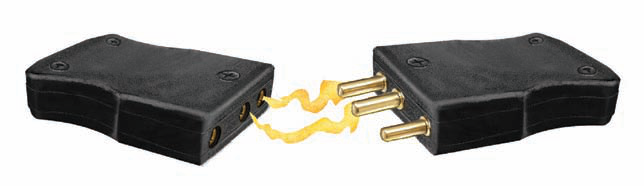
In milder cases, the arc will damage the contacts, reducing conductivity and, with each occurrence, eventually lead to heat rise. In more extreme circumstances, the electrical arc can literally vaporize the contact metal resulting in an unsafe and unusable connection.
Connectors are therefore designed to withstand connection and disconnection while the circuit is energized or deenergized. Contacts that are designed to withstand current rupture are simply larger than their counterparts. Therefore, Nationally Recognized Test Laboratories (NRTLs) such as UL and SDA “list” connectors “for make or break under load” or “not for make or break under load”. Connectors listed for make or break under load are inherently larger than those that are not.
Connector Types Found in Portable Power Applications
Below is a list of the most common connector types for entertainment applications where portability indicates that they may be connected and disconnected regularly.
| Connector Type | Listing Status* | Make/Break Energized |
|---|---|---|
| Single pole cam type | Listed to UL1691 | No |
| NEMA Wiring Devices | Listed to UL498 | Yes |
| IEC60309 Pin and Sleeve | Listed to UL1682 | Yes |
| 7 Pin Cylindrical Connectors | UL Recognized | No |
| Stage Pin Connectors | Listed to UL 498 | No |
| Powercon Connectors | UL Recognized | Yes |
| True One Connectors | UL Recognized | Yes |
* Check the specific manufacturer for their NRTL approval details. We have listed the most common approval for each connector family. Users should always consult the manufacturer’s instructions and product Listing to determine the intended method of operation rather than relying solely on appearance or previous experience.